At Hoselink, we’ve been helping Australians water their gardens since 1999. Every sprinkler mentioned below is one we design, test and sell ourselves, so the advice here comes from years of real experience in Aussie backyards, from small courtyards to sprawling rural blocks.
The short answer
The best garden sprinkler depends on two things: your lawn’s shape and your water pressure. Oscillating sprinklers suit rectangular lawns, round and pulsating sprinklers cover large circular areas, and adjustable models with several spray patterns handle small or awkward spaces. For longevity in the harsh Australian sun, choose a sprinkler with a metal body over cheap plastic, because plastic tends to go brittle and crack after a summer or two outdoors. If you want a quick recommendation, a metal oscillating sprinkler is the most versatile choice for the average suburban lawn, while a sprinkler with multiple spray patterns is the smarter pick for smaller or oddly shaped gardens.
The main types of garden sprinkler explained
Before you compare specs, it helps to understand how each style actually waters your garden. There’s no single “best” sprinkler; each type is designed for a different shape of space and a different level of water pressure. You can see the full range in our sprinkler collection.
Oscillating sprinklers
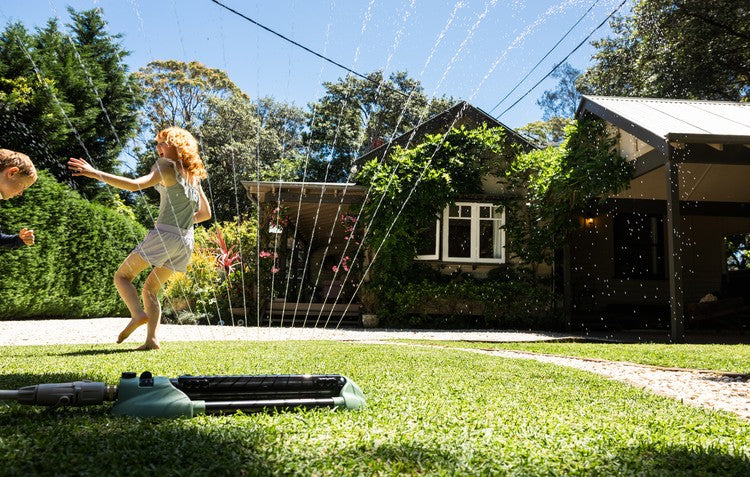
An oscillating sprinkler has a horizontal bar with a row of jets that sweeps back and forth, throwing water in a rectangular fan. This makes it the natural match for rectangular and square lawns, which is what most Australian backyards actually are. The better models let you adjust the width and range of the spray, so you can water a narrow strip along a fence, cover only one side of the lawn, or open it right up for a large area. Oscillating sprinklers are also gentle on the garden, with a fine spray like light rainfall that suits new lawn and garden beds, and they generally work well even where water pressure is on the lower side.
Round and rotating sprinklers
A round sprinkler delivers a 360° circular spray from a fixed base, while rotating (or “rotary”) sprinklers use spinning arms to fling water outward in a circle. Both are ideal for open, roughly circular areas and are about as simple as watering gets: connect, turn on, done. Because the water is thrown in a full circle, they’re less efficient on square lawns (the corners miss out and paths can get wet), but for a large open patch they’re quick and easy. They do tend to need reasonable water pressure to reach their full radius.
Wobble sprinklers for low pressure
If low water pressure is your reality (common on rainwater tanks, rural properties or the end of a long hose run), a wobble sprinkler is built for exactly this job. A wobbling head breaks the stream into large droplets that fall like rain rather than a fine mist, so you still get even coverage without needing strong pressure to push the water out. Droplets also drift less in the wind and evaporate more slowly than mist, which means less wasted water.
Sprinklers with adjustable patterns
An adjustable sprinkler such as our 9-Pattern Sprinkler has a dial that switches between several spray shapes, typically a mix of circles, squares, arcs and narrow rectangles. This flexibility makes it the most versatile option for small, awkward or oddly shaped gardens where a single fixed pattern would either miss spots or spray the neighbour’s fence. You simply turn the dial to the shape that fits, so you only water where you actually want to.
Pulsating (impact) sprinklers
Pulsating or impact sprinklers, the ones that make that distinctive rapid clicking sound, shoot a strong jet in a rotating circle and cover the largest area of any sprinkler that fits on the end of your hose. They’re the type professional groundskeepers reach for on big lawns and acreage. The catch is that they need medium to high water pressure to perform, so they’re not the answer for a garden with low pressure.
How to choose a sprinkler
- Lawn shape. Match the spray pattern to the area: a rectangular coverage for a rectangular lawn, a circular throw for open space, an adjustable pattern for odd shapes. Getting this right is the single biggest factor in even, efficient watering.
- Coverage area. Check the area each sprinkler covers against the size of your lawn. A sprinkler that comfortably reaches across your space saves you constantly moving it around; one that’s too small for the job means dry patches and wasted time.
- Water pressure. Some sprinklers (especially pulsating and round types) need decent pressure to reach their full range, while oscillating and wobble sprinklers are far more forgiving. If you’re on tank water or notice a weak flow at the tap, favour a design made for low pressure.
- Build quality. Sprinklers with a metal body withstand UV and heat far better than plastic, which can go brittle and crack over an Australian summer. A metal base also gives the sprinkler weight, so it stays put instead of tipping over.
- Water efficiency. A sprinkler that matches your lawn shape wastes less water on paths and fences. Pair it with a tap timer and water early in the morning to get the most out of every litre, which matters most under water restrictions.
Sprinkler types compared
| Type | Coverage shape | Pressure need | Best for | Durability |
|---|---|---|---|---|
| Oscillating | Rectangle | Low to medium | Rectangular lawns | High (metal) |
| Round / rotating | Circle | Medium | Medium round lawns | High (metal) |
| Wobble (low pressure) | Circle | Low | Gardens with low pressure | High (metal base) |
| Adjustable patterns | Adjustable (9 patterns) | Low to medium | Small or awkward spaces | High (metal base) |
| Pulsating / impact spike | Circle (adjustable) | Medium to high | Large areas, long reach | High |
How much area do you need to cover?
A quick way to shortlist a sprinkler is to measure your lawn and match it to a sprinkler’s coverage. As a rough guide, a small courtyard or strip is under 50m², an average suburban backyard lawn is around 100 to 200m², and anything above that starts to need either a sprinkler with a longer reach or a bit of repositioning. A good oscillating sprinkler can cover up to around 180m² in one placement, which is enough for most suburban lawns without moving it at all. For larger blocks, either step up to a pulsating sprinkler or plan to run the sprinkler in two or three positions.
Why metal beats plastic in the Australian sun
It’s tempting to grab the cheapest sprinkler off the shelf, but build quality is where the money really shows over time. Australian summers are brutal on garden gear: constant UV exposure and heat cause cheap plastic to fade, warp and eventually crack, often within a season or two. Once a plastic sprinkler cracks at a joint or base, it’s usually landfill. Every sprinkler in our range uses metal construction, which holds up far better against sun and heat, and the extra weight of a metal base keeps them planted firmly on the ground instead of tipping over while they run. A slightly higher upfront cost on a metal sprinkler that lasts many years works out cheaper, and less wasteful, than replacing a plastic one every summer.
Watering efficiently (and under restrictions)
With water restrictions a regular part of life across much of Australia, how you water matters as much as what you water with. A few simple habits make a real difference. Water early in the morning, when it’s cool and still, so far less is lost to evaporation and wind, because watering in the middle of the day can lose a large share of every litre before it soaks in. Match the sprinkler pattern to your lawn shape so you’re not spraying paths, driveways and fences. And pair your sprinkler with a tap timer so watering shuts off automatically after a set time; this stops you overwatering, keeps you within any allotted watering windows, and means you never come home to a sprinkler that’s been running all afternoon. Always check your local council’s current water restrictions, as permitted days, times and methods vary by region and season.
Best for your situation
- Rectangular lawn: a metal oscillating sprinkler gives even coverage from one edge to the other.
- Large open area: a round or pulsating sprinkler throws furthest across a circular area.
- Small or oddly shaped space / garden beds: an adjustable sprinkler with multiple patterns lets you dial in the spray so you only water where you want.
- Low water pressure: favour an oscillating or wobble sprinkler over an impact unit that needs a lot of pressure.
Our picks
All of Hoselink’s sprinklers use metal construction for sun and heat resistance, and each one connects to the same Hoselink fittings as the rest of your system, with no tools needed.

Oscillating Sprinkler ($79.90)
Best for rectangular lawns. Metal construction with water flow control and adjustable spray settings. The rectangular coverage adjusts to water an area up to 15m × 12m (around 180m²), and it performs well even at lower water pressure, ideal against an edge or on a narrow strip.

9-Pattern Sprinkler ($39.90)
Best for small or awkward spaces. Nine spray patterns on a solid metal base, so you can dial in exactly the shape you need, from a gentle soaker to a narrow rectangle. Most patterns reach up to around 6m with good pressure, and it only waters where you point it.

Classic Round Sprinkler ($19.90)
Best for open round areas. An all metal, evenly weighted sprinkler that delivers a 360° circular spray reaching up to 6m. Simple, sturdy and reliable, though it works best with decent water pressure.

Low Pressure Wobble Sprinkler ($46.90)
Best for gardens with low pressure. A sturdy metal base and wobble head disperse water up to a 6m diameter (around 28m²), emitting droplets rather than a fine mist to cut water waste. You can link several together with your hoses to cover a larger area.
Setting up and connecting your sprinkler
Each Hoselink sprinkler comes already fitted with a Hoselink Accessory Connector, so if your hose is already on the Hoselink fitting system, it clicks straight on, with no tools, no threading and no leaks. If you’re new to Hoselink, you’ll need to convert your hose to Hoselink fittings first (a starter kit is the easiest way to do this). Once connected, position the sprinkler in the centre of the area you’re watering, turn the tap on gradually, and adjust the spray width or pattern to suit. For the best results, avoid running it during the heat of the day.
Caring for your sprinkler
A little maintenance keeps a good sprinkler working for years. Rinse it after use if you’re watering with bore or tank water, as sediment can block the fine jets over time; several of our sprinklers include a filter and cleaner built into the unit to help with this. Store it out of direct sun over winter to protect the seals, and give the nozzles an occasional clean with a soft brush if the spray starts to look uneven. Because the bodies are metal rather than plastic, there’s no brittle casing to crack, so with basic care they’ll see out many summers.
Related links