Flow rate is how much water your hose actually delivers, measured in litres per minute (LPM). Pressure pushes the water; flow rate is what arrives. Most Australian garden taps deliver 10 to 20 LPM. You can measure yours in two minutes with a bucket and a phone timer, and the result decides which sprinkler will work.
Two numbers describe your outdoor tap, and almost everyone confuses them. Get them straight and every watering decision, from which sprinkler to buy to why your hose underperforms, gets easier.
Flow rate vs water pressure: what is the difference?
Pressure is the force behind the water, measured in PSI or kPa. Flow rate is the volume that actually comes out, measured in litres per minute. High pressure with a narrow, kinked or badly fitted hose still gives you poor flow. That is why a sprinkler can underperform on a tap that feels strong.
Put simply: flow rate is the number that decides what you can run. Pressure is the number that decides whether the fittings hold.
How to measure your flow rate in two minutes
No tools, no meter, no guessing:
- Take a bucket of known volume. A standard 9-litre bucket is ideal.
- Connect the hose you actually use, with nothing on the end. Testing a bare tap tells you about the tap, not your setup.
- Turn the tap fully on and time how long the bucket takes to fill.
- Divide the bucket volume by the seconds, then multiply by 60.
A 9-litre bucket filling in 30 seconds is 18 LPM. Filling in 60 seconds is 9 LPM. That single number tells you more about your watering options than any product spec.
Do it twice, once in the morning and once in the early evening. Mains pressure drops during peak demand in most suburbs, and the evening figure is the one your sprinkler timer will actually get.
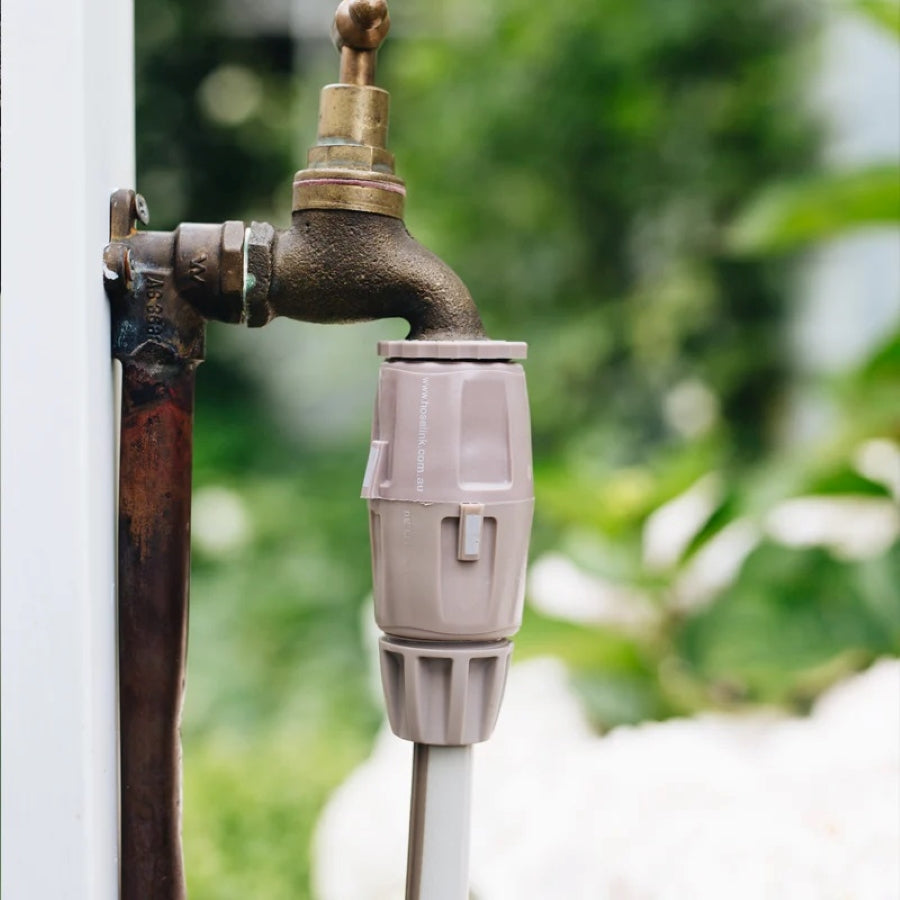
Want an exact reading without the maths? A Water Flow Meter screws straight onto the tap and shows litres per minute directly, along with total litres used, so you can skip the bucket entirely.
LPM to GPM: a quick conversion
Most Australian products are rated in litres per minute, but you will still see gallons per minute (GPM) on some imported gear and in overseas guides. One US gallon is 3.785 litres, so to convert LPM to GPM you divide by 3.785 (or multiply GPM by 3.785 to go the other way).
- 8 LPM is about 2.1 GPM
- 15 LPM is about 4.0 GPM
- 20 LPM is about 5.3 GPM
- 25 LPM is about 6.6 GPM
What flow rate do you actually need?
Most Australian garden taps deliver somewhere between 10 and 20 LPM (about 2.6 to 5.3 GPM). Here is what that buys you.
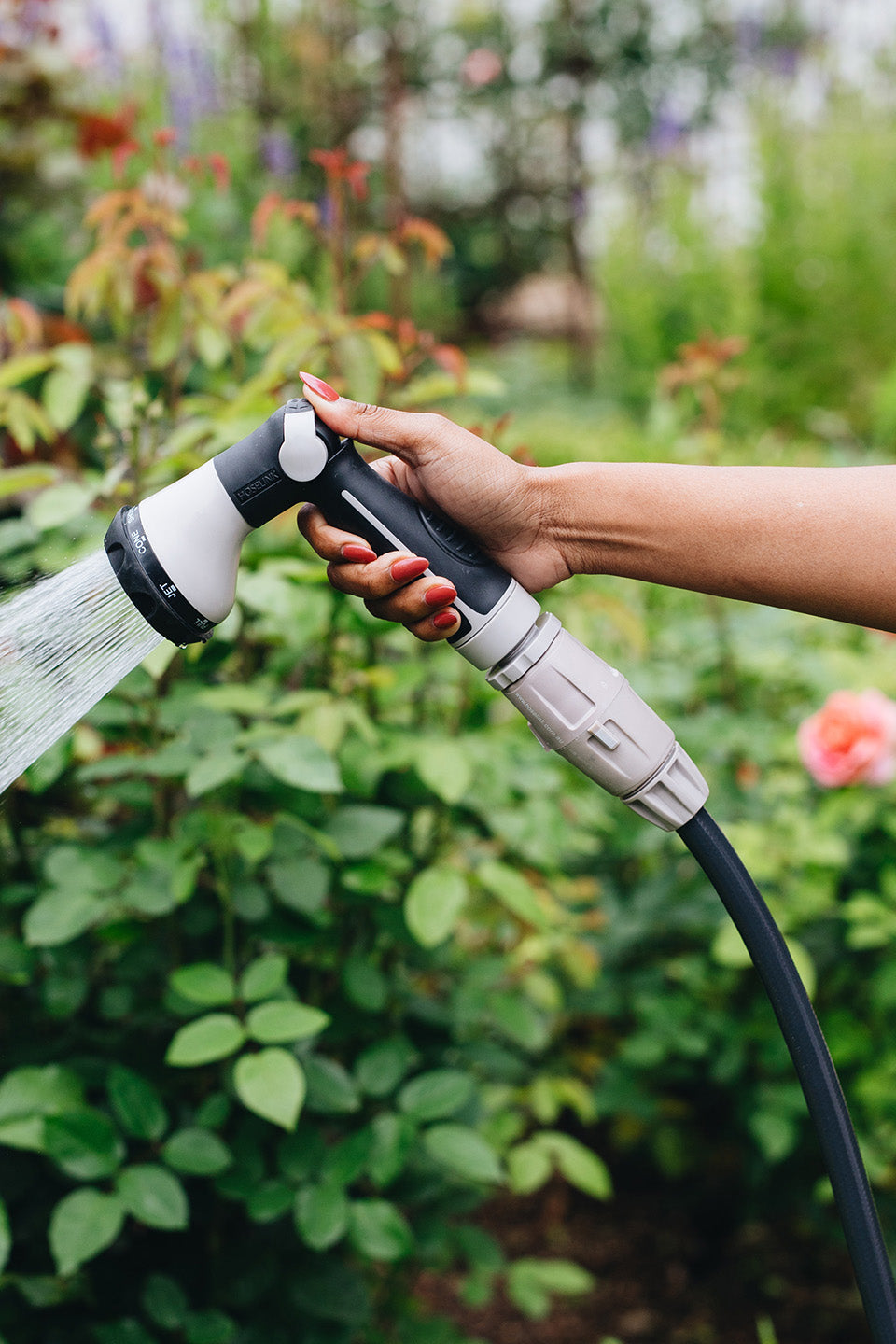
Under 8 LPM. Low. A single hand-held nozzle or a drip system will be fine. Most oscillating and multi-arm sprinklers will not reach their rated coverage, and running two outlets at once will disappoint. A low-pressure wobble-type sprinkler is the design that copes best here.
8 to 15 LPM. Typical suburban. One sprinkler at full coverage, or a nozzle, or a modest drip run. Not two sprinklers at once.
15 to 25 LPM. Good. Two outlets via a splitter, a full oscillating sprinkler at its rated width, or a long drip run.
Above 25 LPM. Excellent, and increasingly rare on newer developments. You are limited by hose diameter and fittings, not by the tap.
Where flow gets lost, in order of how much it costs you
Hose internal diameter. The biggest single factor, and it is not linear. Flow through a pipe scales roughly with the fourth power of the radius, so even a small widening delivers a large gain. A wider-bore hose carries meaningfully more water than a narrow one at the same pressure, which is why diameter, not the tap, is usually the first thing to check when flow is poor. Most standard garden hoses sit around 12mm internal diameter, so a full-bore hose and full-flow fittings make a real difference at the nozzle.
Hose length. Every metre adds friction. Doubling the length measurably drops flow at the far end. Use the shortest hose that reaches, not the longest one you own.
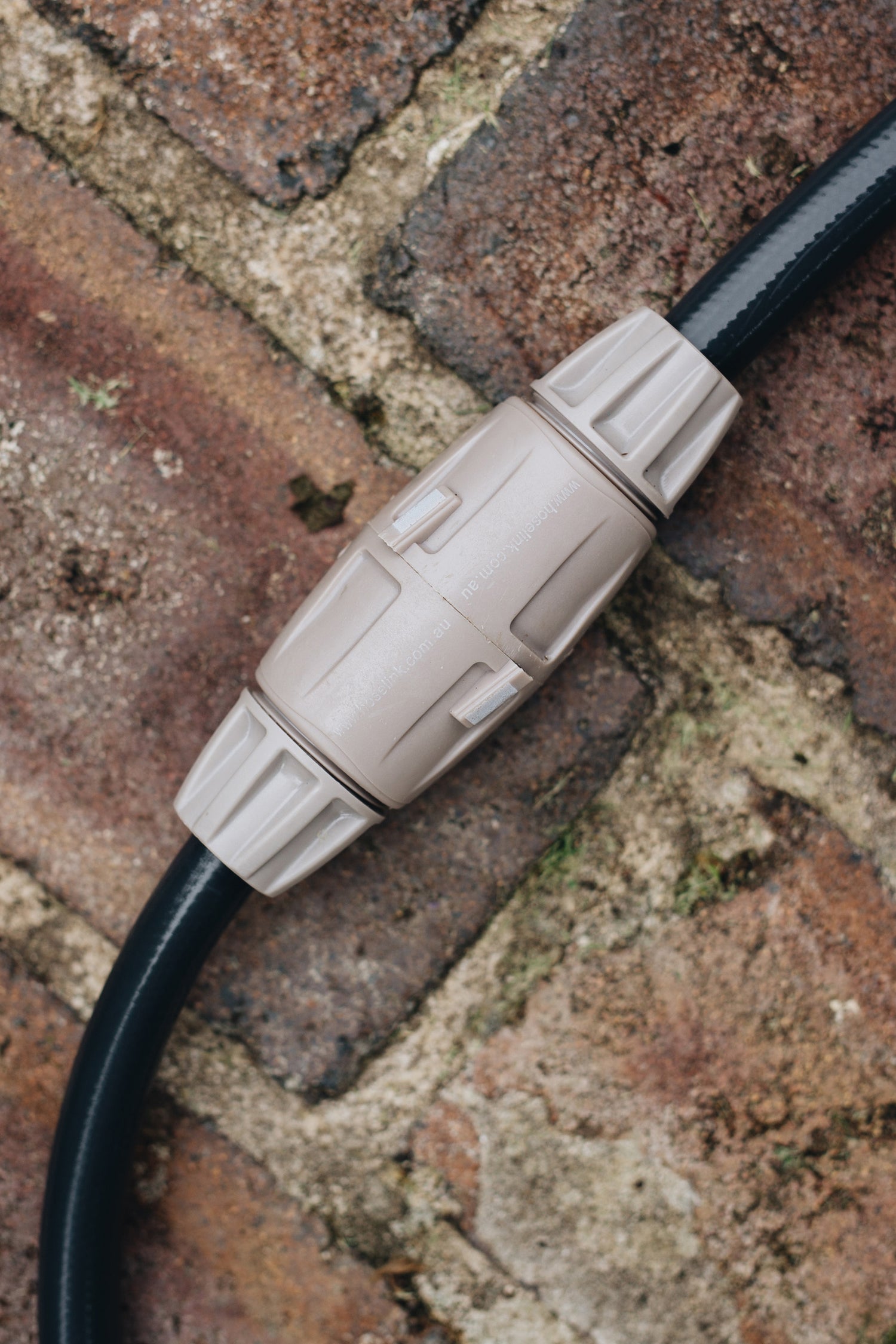
Restrictive fittings. A connector with a narrow internal bore throttles everything downstream, no matter how good the hose is. A fitting is a pipe too, and its narrowest point sets the ceiling.
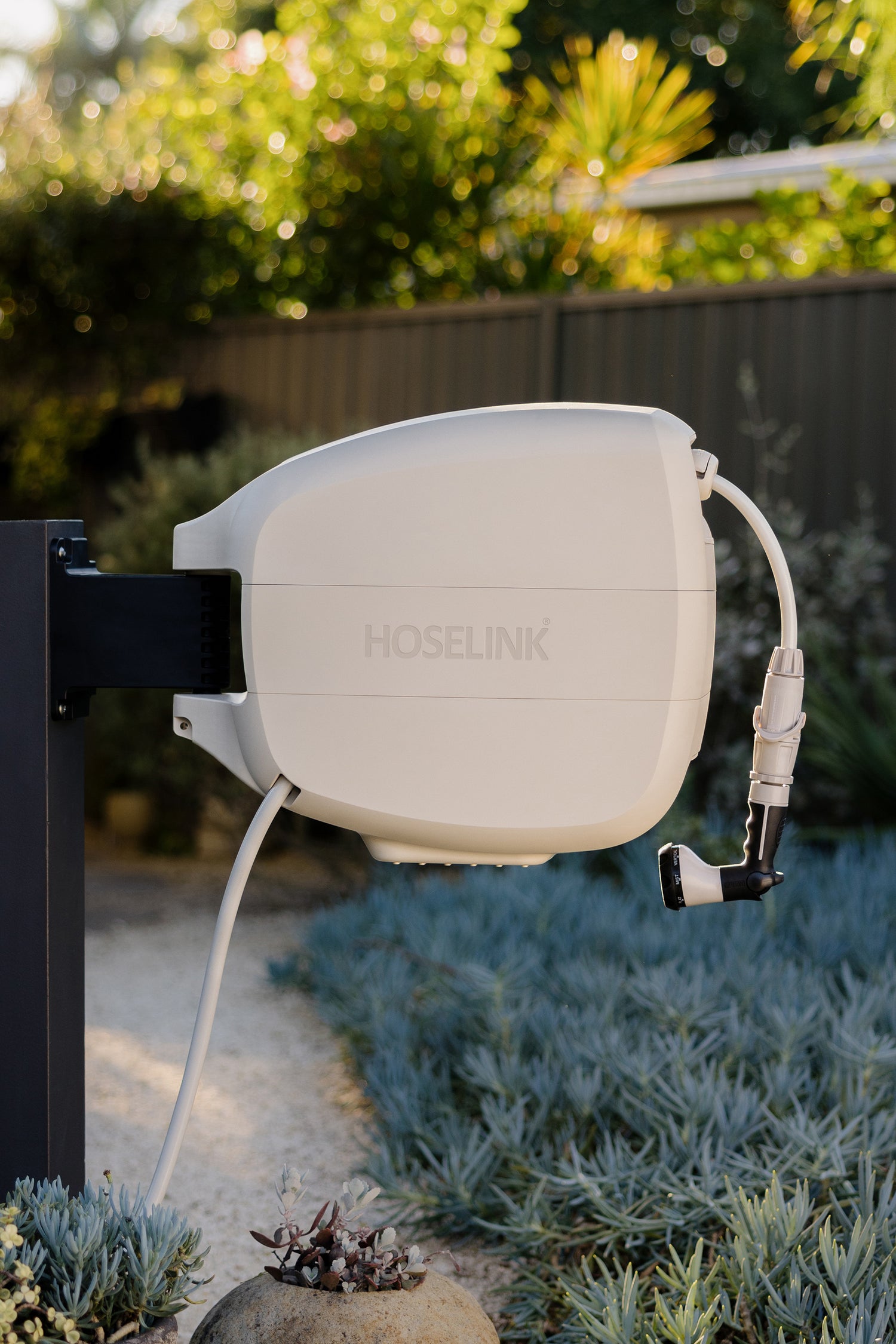
Kinks. A kink is a momentary near-total blockage. This is not a small effect, and it is the one you can fix for free by storing the hose on a reel rather than in a coil on the ground.
Height. Every metre you lift water costs you roughly 10 kPa of pressure. Watering a first-floor balcony or an uphill bed measurably reduces what arrives.
How to increase your garden hose flow rate
You cannot change what your mains delivers, but you can stop losing it along the way:
- Choose a quality hose with a full-bore internal diameter and matching full-flow fittings, so the bore never pinches in along the line.
- Use the shortest hose that reaches the job.
- Keep the hose kink-free. Storing the hose on a reel prevents the coil-on-the-ground kinks that choke flow.
- Check every fitting for a narrow bore, and clear any in-line filter or nozzle that has silted up.
- Still not sure which hose suits your garden? Our guide to which hose to choose walks through diameter, length and fittings.
Pressure: how much should a connection hold?
A typical Australian garden tap runs at roughly 30 to 100 PSI, which is about 200 to 690 kPa. AU plumbing is usually quoted in kPa, so that is the range worth knowing when you are judging whether a fitting is up to the job.
Hoselink quick-connect fittings were independently tested by the CSIRO. The testing showed they could be subjected to over 200 PSI and would never burst off the tap or hose, comfortably above anything a household tap will produce. So if a connection leaks at normal pressure, that is a seal problem, not a pressure problem.
Will my pressure run a sprinkler?
This is the question behind most flow-rate searches, so here is the direct answer: measure your LPM with the bucket test, then match it to the sprinkler’s rated requirement rather than to its rated coverage. A sprinkler quoted at a 12-metre diameter achieves that at its rated flow. Give it half the flow and you get considerably less than half the coverage, because the throw depends on the jet velocity.
If your test comes in under 8 LPM, choose a design built for it. A low-pressure wobble sprinkler distributes evenly at flows where an oscillating bar simply dribbles.
Flow rate from a rainwater tank
Gravity-fed rainwater tanks deliver far less pressure than mains, so flow at the hose end is low, often too low to run a standard sprinkler. A tank outlet usually needs a pump to reach useful sprinkler flow. For tank watering without a pump, stick to a hand nozzle, a weeper hose or a low-pressure wobble sprinkler, and run the bucket test at the tank tap so you know exactly what you are working with.
Your flow rate at a glance
| Your test result | Rating | What it will run | What to avoid |
|---|---|---|---|
| Under 8 LPM | Low | Hand nozzle, drip line, low-pressure wobble sprinkler | Oscillating bar, two outlets at once |
| 8 to 15 LPM | Typical | One sprinkler at coverage, nozzle, modest drip run | Running two outlets at once |
| 15 to 25 LPM | Good | Two outlets via a splitter, full oscillating sprinkler | Long, thin hose runs |
| Above 25 LPM | Excellent | Anything in the range, simultaneously | A narrow or kinked hose (it becomes the limit) |