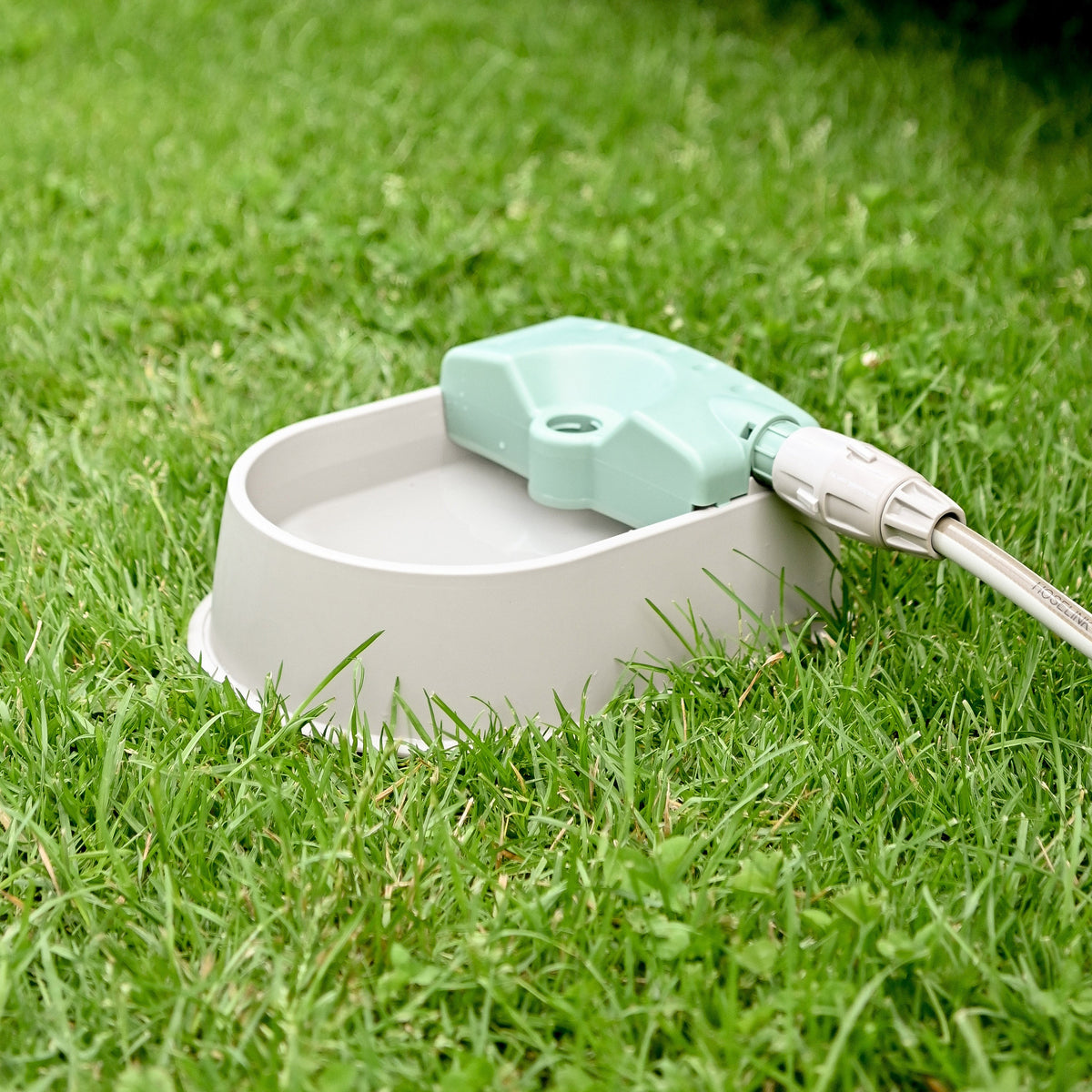
An automatic dog water bowl connects to a garden tap by a hose and refills itself using a float valve, the same mechanism as a toilet cistern. As your dog drinks and the water level drops, the float drops with it, opens the valve and lets water in until the level is back up. There is no power, no battery and nothing to plug in.
If you have ever come home on a 38-degree day to find the dog's bowl dry, you already understand the problem. A bowl holds what it holds. Dogs drink more in heat, tip bowls over, and empty them faster than anyone plans for. An automatic bowl removes the whole question.
How does an automatic dog water bowl work?
The mechanism is deliberately simple: a float valve, the same idea as the one inside a toilet cistern.
The bowl connects by hose to a garden tap, which you leave turned on. Inside the bowl, a hidden float sits on the water surface. When your dog drinks and the level drops, the float drops too, which opens a small valve and lets water in. As the level rises, the float rises with it and closes the valve again. The bowl sits permanently at the same level, topped up continuously, all day.
There is no pump, no power point, no battery and no filter to change. Nothing to fail except the float and the washer, and both are replaceable. On Hoselink's Auto-fill Pet Water Bowl, the float is a stocked spare part, so a worn float means a $14 replacement, not a new bowl.
Do you need power or batteries?
No. This is the most common question, and the answer is the point of the whole design. A float-valve bowl runs entirely on your mains water pressure. It is not the same as a pet drinking fountain, which uses a pump and a power point to recirculate a fixed reservoir of water. An auto-fill bowl draws fresh water straight from the tap every time the level drops, so it never runs down as long as the tap is on.
Who it actually suits
An automatic bowl earns its keep if any of these describe you.
You are out all day. The single most common reason people buy one. A bowl that refills itself is the difference between "probably fine" and knowing.
You have more than one pet. Multiple dogs empty a fixed bowl fast, and the last one to drink gets the least. The Hoselink bowl suits dogs, and also cats, birds and other small animals.
You have a big or active dog. Large breeds and working dogs drink volumes that make a standard bowl a twice-a-day job.
You live somewhere hot. Through an Australian summer, water consumption goes up sharply and a dry bowl becomes a genuine welfare issue rather than an inconvenience.
You travel or go away for a night. With a pet sitter or a neighbour looking in, an auto-fill bowl removes the one job that cannot be skipped.
It is less useful for indoor-only dogs with no access to an outdoor tap, and for puppies being toilet-trained on a controlled water schedule. One caveat worth being honest about: if your dog has a habit of chewing through garden hoses, think carefully before running a hose across the yard to a bowl.
No outdoor tap? There is a workaround
The float valve does not actually care where the water comes from, only that there is some pressure behind it. If you cannot run a hose to a tap, the Hoselink bowl can be fed from a standard P.E.T. drink bottle (not supplied) filled with water and inverted into the inlet. It is a smaller reservoir than mains water, so it is a top-up solution rather than a set-and-forget one, but it keeps the same hands-off refilling on a balcony or courtyard with no tap.
How to set up an automatic dog water bowl
- Pick the spot first. Shade, all day, not just shade at the time you are installing it. Water sitting in full sun gets unpleasantly warm, grows algae faster and evaporates. Somewhere the dog already chooses to lie is usually the right answer.
- Work out the hose run. Measure from the tap to that spot. The Hoselink bowl comes with a 1.5m hose; a longer run just needs a length of standard Hoselink hose on the same fitting system. Route it along a fence line or garden edge rather than across a path or a mowing line.
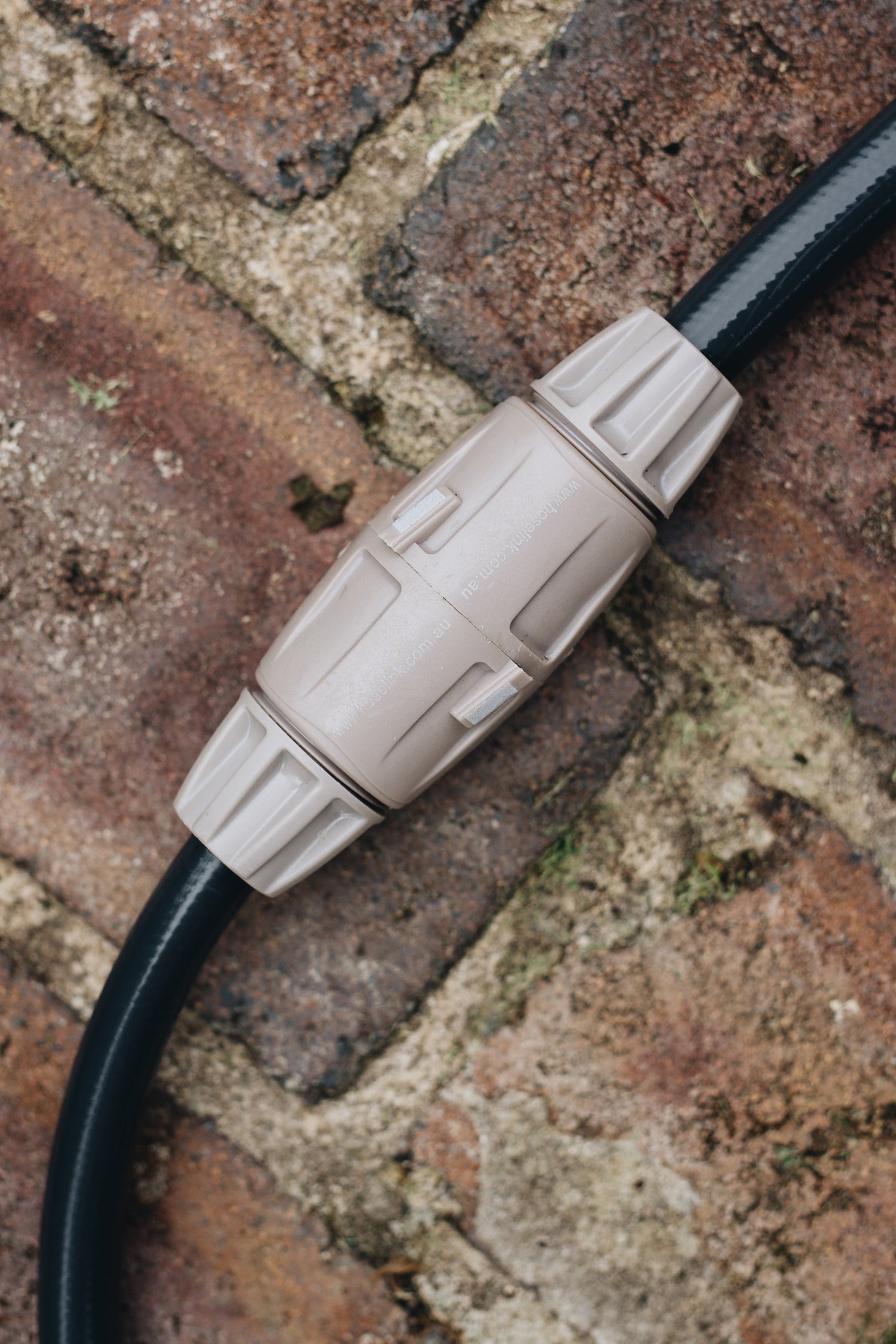
- Connect at the tap. The bowl includes a Universal Tap Connector that screws onto any standard Australian tap, so no separate adapter is needed to get started. If the tap is already in use for the garden hose, a two-way tap adapter lets the bowl and the hose share one outlet, so you are not choosing between watering the garden and watering the dog.
- Turn the tap on and check the level. Let the bowl fill and confirm the float closes the valve cleanly. Check for drips at the tap connection and at the bowl inlet. Then leave the tap on. It is meant to stay on.
- Watch the dog find it. Most dogs take to it immediately. A few are put off by the movement of the water refilling. If yours hesitates, leave the old bowl alongside for a couple of days and it will sort itself out.
Will it stay put?
A lightweight bowl gets tipped, especially by a big dog. The Hoselink bowl has a rubber-grip base to hold it in place, and for a determined pet it can be staked down with tent pegs or screwed to the ground (fixings not supplied). Stability matters more than most people expect: a bowl that gets flipped is a bowl that empties and a float that can jam.
Keeping it clean
A bowl that refills itself still needs washing. Fresh water in does not remove saliva, dust, pollen, leaves or the biofilm that builds on any permanently wet surface.
Once or twice a week, turn the tap off, tip the bowl out, scrub it with hot water and a dedicated brush, and refill. Avoid strong detergents that leave a residue and a taste. Check the float moves freely while you are there. Grit around the hinge is the usual cause of a bowl that has stopped filling, or one that keeps overflowing.
If you are somewhere that gets a hard frost, drain the bowl and the hose over winter, the same as you would any outdoor hose fitting, so trapped water cannot freeze and split anything.
Is a garden hose safe for a dog to drink from?
This is worth getting right. An ordinary garden hose, including the standard PVC hose supplied with most auto-fill bowls, is not made from drinking-water-rated material, and water that has been sitting inside it in the sun can pick up a taste or leach from the hose. For a bowl that tops up and gets used through the day, that turnover is quick. But if the bowl is going to be your pet's main or only water source, run it off a hose rated for drinking water. Hoselink's Drinking Water Hose uses the same quick-connect fittings, so it swaps straight in.
Auto-fill bowl vs standard bowl vs pet fountain
| Auto-fill bowl | Standard bowl | Pet water fountain | |
|---|---|---|---|
| Needs power | No | No | Yes |
| Refills itself | Yes (float valve) | No | No (recirculates) |
| Indoor or outdoor | Outdoor (needs a tap) | Either | Usually indoor |
| Good for multiple pets | Yes | Runs dry | Limited by reservoir |
| Runs dry while you are out | No | Yes | When the reservoir empties |
| Cleaning | Weekly scrub | Daily | Weekly plus filter changes |
| Consumable parts | Float, washer | None | Filters, pump |
What to look at before you buy
The valve, not the bowl. Every auto-fill bowl looks much the same. The part that determines whether it is still working in three years is the float valve and the seal.
Stability. A lightweight bowl gets tipped. Weight, a wide base, a rubber grip or the ability to fix it down all matter more than capacity.
Whether the float can be replaced. It is a wearing part. If it cannot be replaced, the whole bowl is disposable. Hoselink stocks the float as a spare.
How it connects to your tap. A bowl that needs an adapter you do not own is a bowl that sits in the shed. If you already use a quick-connect fitting system on your garden hose, get a bowl that connects to the same system. The Hoselink bowl uses Hoselink's own no-leak fitting system, so it shares fittings with the rest of the range.
The hose that comes with it. As above, if the bowl will be your pet's only water source, pair it with a drinking-water-rated hose rather than a standard garden hose.
The Hoselink Auto-fill Pet Water Bowl at a glance
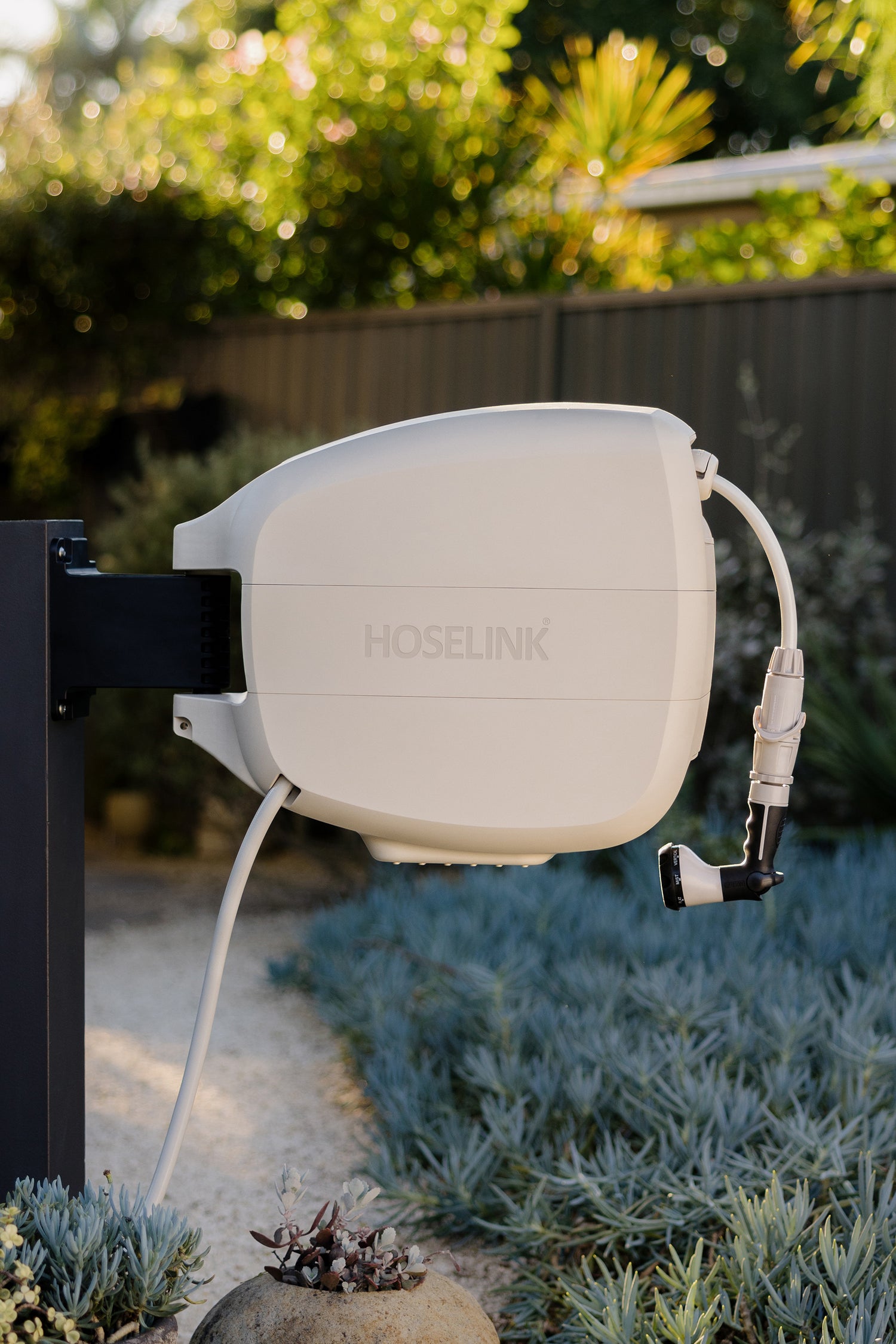
The Hoselink Auto-fill Pet Water Bowl is $69.90 and comes as a complete kit: the 1.2L bowl with its float mechanism, a 1.5m hose with fittings, an accessory connector and a Universal Tap Connector to screw onto the tap. It is UV resistant for life outdoors, suits small to medium dogs as well as cats and birds, carries a 12-month warranty, and the float is available separately as a spare. It rates 4.6 out of 5 from more than 210 reviews, and like the rest of the range it is backed by an Australian owned and operated business.
If you are also setting up timed watering for the garden while you are at it, it is worth reading why a tap timer pairs well with a permanently connected tap, and browsing the full Pets range.