Vertical gardening means training plants to grow upwards on a support instead of sprawling across the bed, and it is one of the simplest ways to grow more food in less space. Growing up lifts your yield, improves airflow, keeps fruit clean and frees the soil below for more crops. This guide covers why it works, what to grow, and how to do it in a raised bed.
Quick answer: Vertical gardening uses a trellis or frame to grow climbing plants upwards rather than outwards. It saves space, increases yield, improves airflow to reduce fungal disease, and makes crops easier to see and pick. Great climbers include tomatoes, cucumbers, beans, peas and passionfruit. Position the support on the sunny side, train young growth as it goes, and water at the base.
Table of contents
• What is vertical gardening, and why grow up?
• How does a raised-bed trellis work?
• What can you grow vertically?
• How do you train plants up a trellis?
• Make the most of the space beneath
• Watering and caring for vertical crops
• Common vertical gardening mistakes
• Frequently asked questions

6 in 1 Metal Raised Garden Bed | 43cm Tall | Sage

9 in 1 Metal Raised Garden Bed | 43cm Tall | Sage

What is vertical gardening, and why grow up?
Vertical gardening is training climbing and vining plants up a support such as a trellis, rather than letting them spread across the ground. Most gardeners think of growing space in two dimensions, the footprint of the bed. Growing up adds a third dimension, so a small bed can produce far more.
The benefits stack up quickly:
• More food in less space. Train tomatoes or cucumbers upward and you free the soil below for companion crops.
• Better airflow, less disease. Fungal diseases like powdery mildew and blight thrive in still, humid air at ground level. Lifting plants off the soil reduces that risk, without any sprays.
• Cleaner, straighter fruit. Cucumbers and beans that hang freely are easier to spot and pick, and less likely to rot or curl on the soil.
• Easier on your back. Harvesting and checking plants at eye level means less bending and searching through foliage.
• Shade, screening and looks. A covered trellis can screen a fence or create a green feature, while shading tender crops below in summer.
How does a raised-bed trellis work?
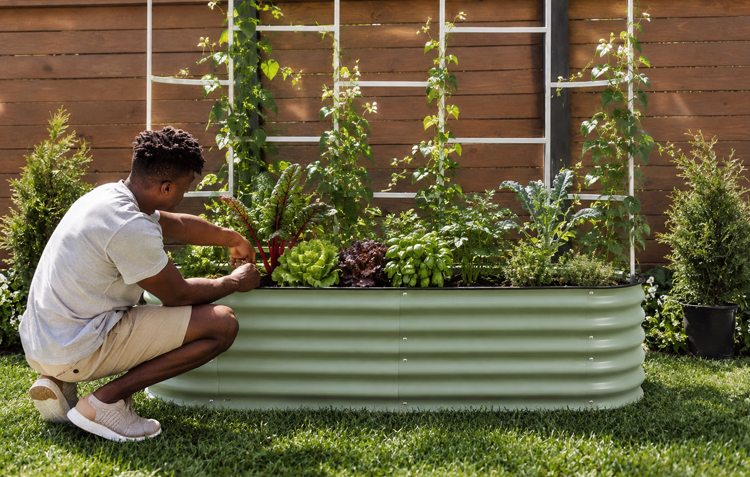
A raised-bed trellis is a vertical frame that attaches to the bed and gives climbing plants something to grow up. The Hoselink Metal Wall Trellis is made specifically for the Hoselink Metal Raised Garden Beds, attaching cleanly to the bed frame with all hardware included.
It is built from the same Zn-Al-Mg coated steel as the beds, so it shrugs off sun and rain season after season. Each trellis suits a specific bed configuration: the 6-in-1 trellis fits the 198 x 61cm layout, and the 9-in-1 trellis fits the 244 x 61cm layout. Note the trellis and the Year-Round Greenhouse System are designed to be used one at a time, not together on the same bed.


What can you grow vertically?
The best crops for a trellis are natural climbers and vines that would otherwise sprawl. Tomatoes, cucumbers, beans, peas and passionfruit are the classics, but plenty of flowers climb beautifully too. Match the plant to the support and let it do what it wants to do.
• Vegetables: climbing (pole) beans, snow peas and snap peas, cucumbers, and indeterminate (vining) tomatoes trained up the frame.
• Fruit and heavy croppers: passionfruit, and smaller melons or squash if you support the fruit in a sling made from soft fabric or old stockings.
• Flowers and vines: sweet peas, climbing roses, jasmine and most flowering climbers add colour, scent and pollinators.
Avoid trying to grow bush varieties up a trellis. A bush bean or a determinate tomato is bred to stay compact, so it won't climb. Check the plant tag for words like climbing, vining, pole or indeterminate.

How do you train plants up a trellis?
Train plants up a trellis by guiding the young growth onto the frame early and tying it in loosely as it grows. Most climbers will grip on their own once started, but a little help at the beginning sets the direction and keeps stems off the ground. Check them every week or so through the growing season.
1. Start early, while plants are young and flexible, and position them close to the frame.
2. Guide the leading stems onto the trellis and tie them loosely with soft twine or plant ties, leaving room for the stem to thicken.
3. For tomatoes, pinch out the side shoots and train a main leader up the frame for the cleanest, most productive plant.
4. Keep tying in new growth as it extends, and tuck tendrils onto the frame so nothing flops back to the soil.
Never tie tightly. A tight tie cuts into the stem as it grows and can strangle the plant. A loose figure-eight loop between stem and frame gives support without damage.


Make the most of the space beneath
Once your climbers are heading up, put the freed-up soil to work and position the trellis so it doesn't shade the rest of the bed. Growing vertically opens the ground below for a second layer of low, quick crops, which is where the real space saving comes from.
Underplant with shade-tolerant crops like lettuce, rocket, spinach and leafy herbs, which appreciate a little shelter from the summer sun cast by the taller plants above. This is companion planting at its most practical: two crops from one footprint.
Position matters. In Australia the sun sits in the north, so a tall trellis casts its shade to the south. Place the trellis along the southern edge of the bed so it doesn't shade your other crops, and make sure the climbers themselves get at least six hours of direct sun a day.
Watering and caring for vertical crops
Water vertical crops deeply at the base, not over the leaves, and mulch well to hold that moisture in. Climbers like tomatoes and cucumbers are thirsty when fruiting, and wetting the foliage invites the very fungal diseases that growing up helps you avoid. A soaker hose or drip line at soil level is ideal.
Mulch is your ally here. Applying 7 to 10 centimetres of mulch around plants can save up to 70% of the water otherwise lost through evaporation, which matters for hard-working vertical crops in summer. A weeper or soaker hose on a tap timer keeps water going straight to the roots.

Common vertical gardening mistakes
A few simple missteps trip people up. Avoid these and your vertical crops will thrive:
• Choosing bush varieties instead of climbing ones, then wondering why they won't climb.
• Starting too late, when stems are already woody and sprawling. Train them young.
• Tying stems too tightly, which strangles them as they grow.
• Placing a tall trellis on the sunny side of the bed, so it shades the crops behind it.
• Growing heavy fruit like melons without supporting them, so the weight tears the vine.
• Watering over the leaves, which undoes the disease benefit of growing up. Water at the base.
Frequently asked questions
What is vertical gardening?
Vertical gardening is growing climbing and vining plants upward on a support such as a trellis, rather than letting them sprawl across the ground. It saves space, lifts yields, improves airflow to reduce disease, and makes crops easier to see and harvest. It suits small gardens and raised beds especially well.
What vegetables grow well on a trellis?
Climbing beans, snow and snap peas, cucumbers and vining (indeterminate) tomatoes are the best trellis vegetables, along with passionfruit and, with fruit support, smaller melons or squash. Choose climbing or pole varieties rather than bush types, which are bred to stay compact and won't climb.
Does growing vertically really reduce plant disease?
Yes. Lifting plants off the soil surface improves air circulation and keeps foliage drier, which reduces fungal diseases like powdery mildew and blight that thrive in still, humid air at ground level. Watering at the base rather than over the leaves adds to the benefit.
Where should I position a trellis in a raised bed?
In Australia, place a tall trellis along the southern edge of the bed. Because the sun sits in the north, the trellis casts shade to the south, so this keeps it from shading your other crops. Make sure the climbers themselves still get at least six hours of direct sun.
How do I attach a trellis to a raised garden bed?
The Hoselink Metal Wall Trellis attaches directly to the bed frame with all hardware included, and doesn't touch the soil. The 6-in-1 trellis fits the 198 x 61cm bed layout and the 9-in-1 fits the 244 x 61cm layout. Use all the poles for a full-length trellis or fewer for a narrower run.
Ready to grow up? A trellis is the easiest way to lift your harvest without taking up more room. Explore the Hoselink Metal Raised Garden Bed range and its matching Metal Wall Trellis to turn a single bed into a vertical growing system.